Steg: The Ultra Bold Sans-Serif That Commands Attention
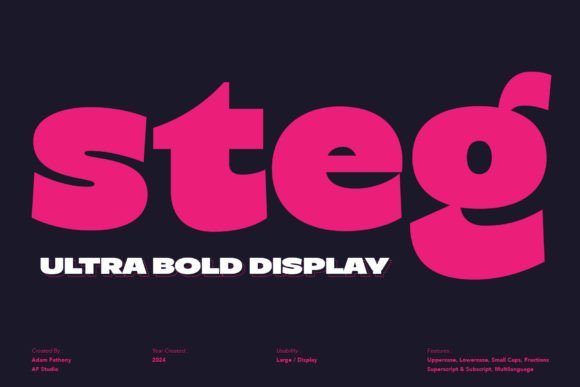
In the crowded landscape of digital design, silence is rarely an option. Whether you are scrolling through a social media feed, walking past a storefront, or browsing a landing page, your eyes are constantly bombarded with information. To cut through this noise, designers need more than just legibility; they need presence. This is where Steg enters the conversation. As an ultra-bold and minimalist sans-serif font, Steg is not designed to whisper. It is engineered to shout with clarity, precision, and contemporary elegance.
But what makes Steg different from the myriad of other heavy-weight typefaces available today? The answer lies in its balance. While many bold fonts sacrifice readability for impact, Steg maintains clean lines and sharp edges that ensure every character remains distinct, even at massive sizes. It is a tool for those who understand that modern simplicity is not about emptiness, but about intentional focus.
Why Minimalism Needs Maximum Weight
There is a common misconception that minimalist design must be light, airy, and delicate. However, true minimalism is about removing the unnecessary to highlight the essential. When you strip away decorative serifs, intricate ligatures, and variable weights, you are left with the raw structure of the letterforms. Steg embraces this philosophy by offering an ultra-bold weight that serves as a structural anchor for any design project.
The sharp edges and clean geometry of Steg exude a sense of confidence. It does not try to be friendly or approachable in a traditional sense; instead, it commands respect. This makes it an ideal choice for brands that want to project authority, innovation, and strength. When you use Steg, you are making a statement that your message is important, urgent, and worthy of immediate attention.
Real-World Applications Across Industries
The versatility of Steg allows it to transcend specific industry boundaries. Its modern aesthetic fits seamlessly into various contexts, provided the goal is high-impact communication. Here is how different professionals can leverage this typeface effectively.
Branding and Identity
For startups and tech companies, first impressions are critical. A logo set in Steg immediately communicates stability and forward-thinking. The font’s multilanguage support ensures that global brands can maintain visual consistency across English, Spanish, French, and other linguistic markets. Imagine a fintech app launching in Europe and Latin America simultaneously; using Steg ensures that the brand voice remains strong and recognizable, regardless of the local language.
Editorial and Publishing
Magazine covers and digital headlines require typography that grabs the reader within seconds. Steg’s bold weight is perfect for mastheads and feature titles. The availability of small caps offers editors additional stylistic options for subheads or introductory paragraphs, creating a hierarchy that guides the eye without cluttering the layout. The alternate ampersand adds a subtle touch of uniqueness, allowing designers to break the monotony of standard characters in pull quotes or section dividers.
Advertising and Campaigns
In outdoor advertising, such as billboards and transit ads, readability from a distance is paramount. Steg’s thick strokes and open counters ensure that messages are legible even at high speeds or from far away. Whether it is a bold call-to-action on a poster or a striking headline on a digital banner, Steg delivers maximum impact. The inclusion of fractions, superscript, and subscript features also makes it suitable for technical advertisements, such as those in the engineering or scientific sectors, where precise typographic composition is necessary.
Navigating Technical Features for Better Design
While the visual impact of Steg is its most obvious strength, its technical features provide the flexibility needed for professional-grade design. Understanding how to utilize these tools can elevate your work from good to exceptional.
- Small Caps: These are not merely scaled-down uppercase letters. They are optically adjusted to match the weight and proportion of the lowercase text. Use them for acronyms or labels to maintain visual harmony without disrupting the flow of reading.
- Fractions and Scientific Notation: For projects involving data, recipes, or technical specifications, the built-in fraction glyphs ensure that numbers look integrated rather than patched together. This attention to detail signals quality and professionalism to the viewer.
- Multilanguage Support: In an increasingly connected world, designing for a single language is often insufficient. Steg’s extensive character set supports diverse linguistic requirements, allowing designers to create inclusive campaigns that resonate with global audiences.
Considerations Before Choosing Steg
Like any powerful tool, Steg requires thoughtful application. Its ultra-bold nature means it is not suitable for long-form body text. Using it for paragraphs would result in visual fatigue, as the heavy weight creates dense blocks of ink that are difficult to scan. Instead, reserve Steg for headlines, titles, logos, and short bursts of text where impact is the primary goal.
Another consideration is spacing. Bold fonts often require adjusted kerning and tracking to prevent characters from appearing too cramped. Because Steg has sharp edges and clean lines, giving it adequate breathing room enhances its modern elegance. Do not be afraid to use generous white space around Steg typography; this contrast amplifies its presence and reinforces the minimalist aesthetic.
Additionally, consider the context of your medium. On low-resolution screens, extremely bold fonts can sometimes lose their sharpness if not rendered correctly. Ensure that your digital assets are optimized for high-DPI displays to maintain the crispness of Steg’s edges. For print, the font’s solid weight translates beautifully, providing a tactile sense of substance on paper.
The Psychology of Bold Typography
Typography is not just about aesthetics; it is about psychology. Bold fonts like Steg evoke feelings of strength, reliability, and urgency. When a user sees a headline in Steg, they subconsciously perceive the message as important. This can be particularly effective in call-to-action buttons or limited-time offers, where the goal is to prompt immediate engagement.
However, this psychological impact must be balanced with tone. Steg is not playful or whimsical. It is serious and direct. If your brand voice is lighthearted or casual, Steg might feel too imposing. But for brands that value precision, luxury, or industrial strength, it is an perfect match. It tells the audience that you are confident in your product and unapologetic in your presentation.
Integrating Steg into Your Workflow
Adopting Steg into your design toolkit is straightforward. Its compatibility with major design software ensures a smooth integration process. Start by experimenting with scale. Try setting a single word in Steg at a massive size against a neutral background. Notice how the negative space interacts with the bold letterforms. Then, introduce the small caps for secondary information. Observe how the hierarchy shifts and how the eye moves through the composition.
Remember, the power of Steg lies in its restraint. Do not overuse it. Let it shine in key moments. Use it to anchor your design, to draw the eye, and to deliver your core message with unwavering clarity. In a world full of visual clutter, Steg offers a refreshing dose of focused intensity. It is not just a font; it is a statement of intent. By choosing Steg, you are choosing to be heard, understood, and remembered.